They said it was unfilmable. For decades, Frank Herbert’s Dune was the white whale of science fiction—a beast so massive, so dense with internal monologues and sand, that Hollywood just couldn’t figure out how to put it on a screen without it crumbling like dry spice cake.
I’ve been obsessed with Arrakis since I was a teenager. I’ve read the book cover-to-cover more times than is probably healthy, and I’ve sat through every adaptation. And let me tell you, when we talk about the “ending” of Dune, we are talking about two completely different realities.
If you’re looking for a quick ranking of great genre films, you might check out our list of the 10 Best Netflix Sci-Fi Movies of 2025: Ranked & Rated, but today, we are hyper-focusing on the desert. We’re pitting David Lynch’s 1984 fever dream against Denis Villeneuve’s 2021 brutalist masterpiece.
Who actually nailed the ending? Let’s fight.
The 1984 Ending: The Rain God Problem
David Lynch is a genius, but his ending to Dune is the stuff of fanboy nightmares.
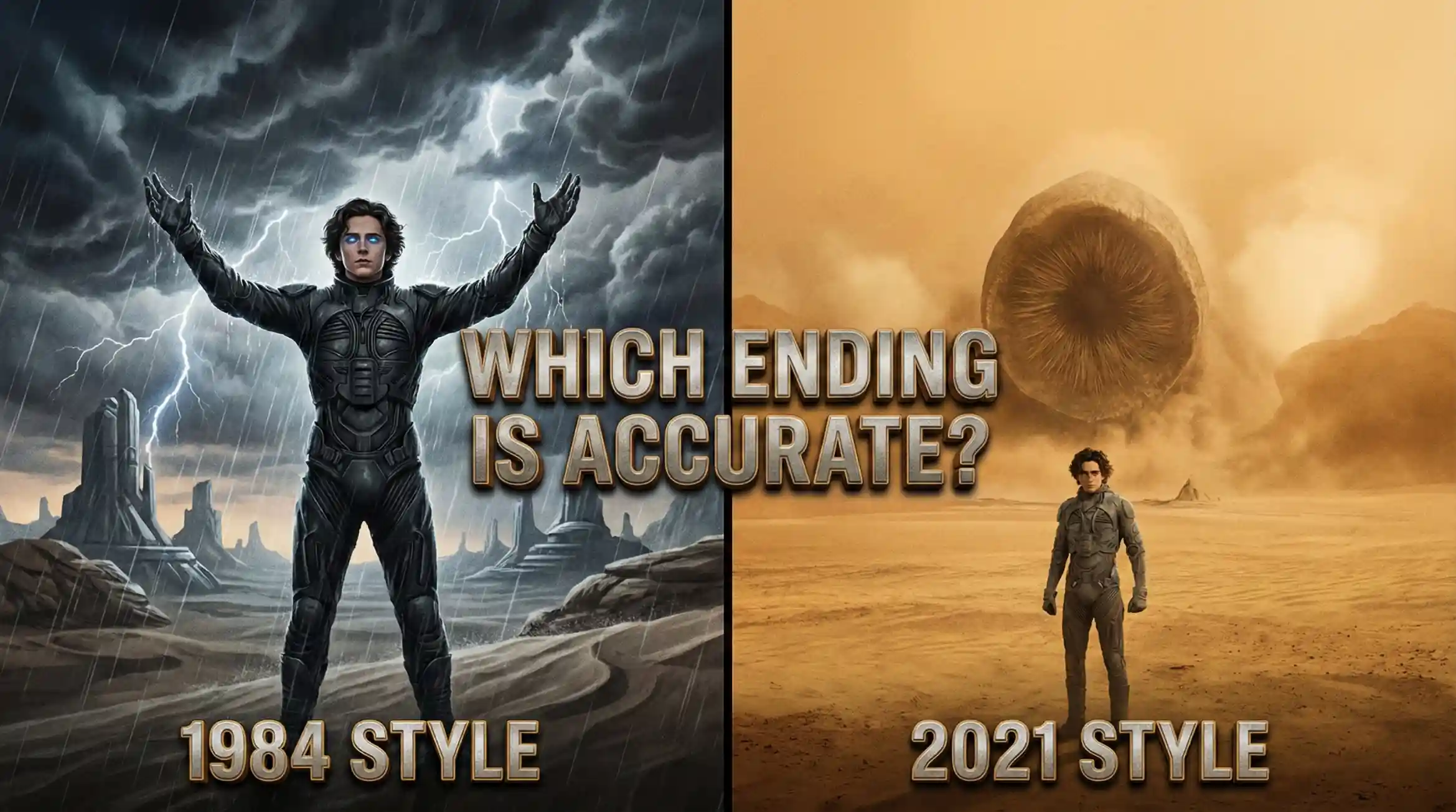
If you haven’t seen the 1984 version recently, let me refresh your memory. After defeating Feyd-Rautha (played by Sting in a winged diaper—an iconic look, honestly) and the Emperor, Paul Atreides stands before the gathered Fremen. His eyes turn blue, he looks at the sky, and he literally makes it rain on Arrakis.
Thunder crashes. Water pours from the heavens. The Fremen celebrate. The end.
Why Book Fans Hated It
Here’s the issue: That never happens. In the book, Paul is a result of a breeding program and rigorous training. He has prescience. He has “desert power.” But he is not a magical weather wizard who can alter a planet’s climate with a thought.
Herbert’s entire point was about ecology. Changing the climate of Arrakis was supposed to be a grueling, centuries-long process—a dream for the future, not an instant miracle. By giving Paul god-like powers to summon rain, Lynch turned a complex sci-fi cautionary tale into a generic “Chosen One” fantasy. It looked cool, but it missed the point entirely.
The 2021 Ending: The Abrupt Cut-to-Black
Then we have Villeneuve’s 2021 version. If Lynch tried to cram too much in, Villeneuve arguably gave us too little. The movie ends right after Paul defeats Jamis in a ritual knife fight.
Paul and Lady Jessica are accepted into the Sietch. They see a Fremen riding a sandworm. Chani looks at the camera and says, “This is only the beginning.” Smash cut to credits.
Why Casual Viewers Were Confused
I remember walking out of the theater and hearing people grumble, “That’s it?” It feels incomplete because, well, it is. It covers roughly the first half of the book.
Ending on a cliffhanger is risky. It leaves you with that agonizing feeling of unfinished business, sort of like the long, painful wait we’ve endured for other sequels. If you’re still traumatized by waiting for closure on Wikus van de Merwe, check out our piece on District 9 Ending Explained: The Metal Flower, The Three-Year Promise to commiserate.
But while the casual audience felt cheated, us book nerds were nodding in approval.
The Verdict: Accuracy vs. Hollywood Spectacle
So, which one is actually “accurate”?
If we are going by the text, Villeneuve’s 2021 ending is vastly superior.
The fight with Jamis is the pivotal moment in the book where Paul transitions from a boy—the Duke’s son—to a Fremen. He has to kill, not out of malice, but out of necessity. It’s the moment his “terrible purpose” truly begins. Villeneuve captures the sorrow and the weight of that death perfectly.
Lynch’s ending, while providing a sense of “closure” for a standalone film, betrays the themes of the novel. Paul Atreides isn’t a savior who fixes everything with magic rain; he’s a charismatic leader trapping humanity on a path to a holy war.
Frequently Asked Questions (FAQs)
Since we are diving deep into the sand, here are a few burning questions you might have about these two adaptations.
Is the 1984 Dune still worth watching?
Honestly? Yes. Despite the messy ending, the production design is wild, the practical effects are gross in a good way, and the soundtrack by Toto is legendary. Just view it as a weird art-house remix of the book rather than a faithful adaptation.
Why was Zendaya barely in the 2021 movie?
A lot of people felt duped by the marketing! Chani (Zendaya’s character) mostly appears in Paul’s visions in the first half of the book. Her role becomes massive in the second half, which is covered in Dune: Part Two.
Why did the 2021 movie end so abruptly?
Denis Villeneuve always planned this as a two-part adaptation. The book is incredibly dense, and trying to squeeze it all into one movie (like Lynch did) results in a rushed mess. The cut-to-black was a bold choice to signal, “Intermission’s over, the real war begins next.”
What about the “Spicediver” edit of the 1984 film?
There is a fan edit floating around the internet that adds deleted scenes and tries to fix the pacing. It’s closer to the book in some ways, but David Lynch had nothing to do with it and disowned the theatrical cut anyway.
Conclusion
Lynch gave us a “Hollywood” ending. Villeneuve gave us a “Herbert” ending.
The 2021 film understands that the story of Dune isn’t about the destination (or the weather); it’s about the shift in power. Sure, it demanded we wait years for Part Two to get the payoff, but I’d rather wait for perfection than watch Paul Atreides turn into a literal rain god again.
If you need something to binge while we argue about spice harvesting, head over to our Top 10 Must-Watch Netflix Movies of 2025 for some solid recommendations.
Winner: Dune (2021). No contest.